Most on-page , SEO checklists online list 40–50 tasks. But they rarely answer the real question: What should you fix first?
Because if you fix the wrong things first, nothing moves in Google Search Console. Pages stay stuck on page 2 or page 3 even after hours of work.
This priority-based on-page SEO checklist shows:
- what to fix immediately
- what boosts rankings later
- what can wait
If you follow this order, many sites see ranking movement within 30–60 days.
If you want this checklist turned into a custom report for your website, request a free SEO audit from SEO audit.
How to Use This On-Page SEO Checklist
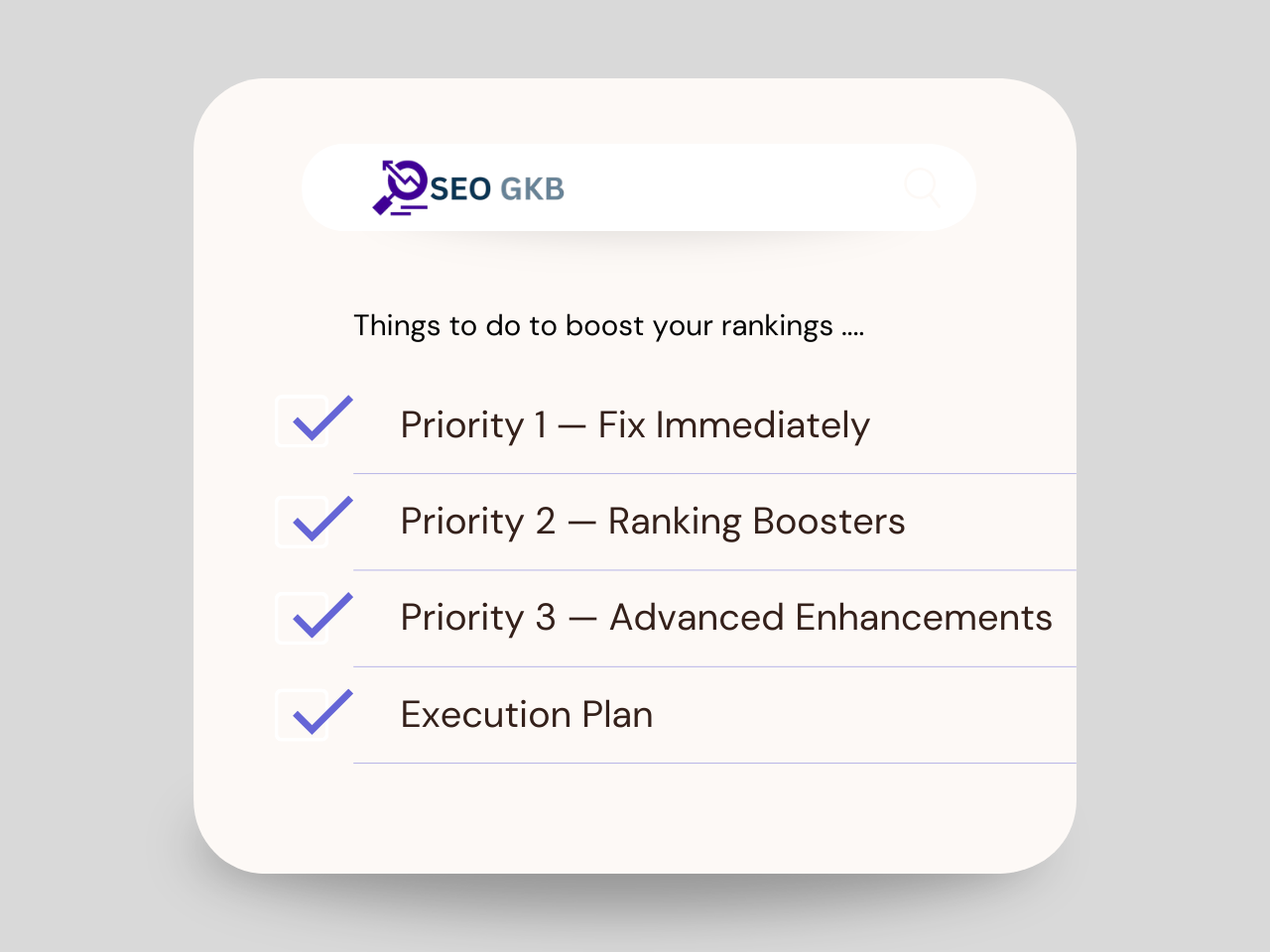
Not all SEO tasks have the same impact. This checklist divides fixes into three priorities.
Priority 1 — Fix Immediately
These directly affect rankings.
Examples:
- Title tags
- H1 headings
- Search intent
- Content depth
If these are wrong, Google struggles to understand the page.
Priority 2 — Ranking Boosters
These help improve authority and user experience.
Examples:
- Internal links
- Heading structure
- Images and layout
These often push pages from position 8 to the top 3.
Priority 3 — Advanced Enhancements
These are useful but not urgent.
Examples:
- Schema markup
- Social tags
- Minor UX tweaks
Micro Example
Before fixing Priority-1 issues
Position: 17
After fixing titles, H1, and search intent
Position: 6
Only three changes created the ranking lift.
Priority 1: Must-Fix On-Page SEO Basics
If you only complete this section, you should still see ranking improvements.
1. Match Search Intent and Target Keyword
Every page should target:
- 1 primary keyword
- 2–4 secondary variations
Example
Primary keyword: on page seo checklist
Secondary keywords:
- on page seo audit
- seo checklist
- on page optimization checklist
How to Check Search Intent
Google the keyword and analyze the top 3 results.
Check:
- content type
- depth
- format
If Google shows mostly guides and checklists, your page must follow the same structure.
If your page is a service page, optimize it for service page SEO instead.
2. Title Tag and H1 Alignment
Your title tag strongly influences rankings.
Checklist:
- Primary keyword near the beginning
- Clear benefit or promise
- Under 60 characters
Example:
Good: On-Page SEO Checklist That Moves Rankings
Bad: SEO Tips Guide Website Optimization
H1 Rules
- Only one H1 per page
- Natural wording
- Should support the title
Example:
Title: On-Page SEO Checklist That Moves Rankings
H1: The Practical On-Page SEO Checklist for 2026
You can evaluate these issues during a SEO title audit.
3. Write Meta Descriptions That Win Clicks
Meta descriptions influence CTR, not direct ranking.
Best practice:
- 140–160 characters
- Keyword included naturally
- Clear benefit
Example:
"Use this priority-based on-page SEO checklist to fix titles, headings, and internal links that
move rankings in 30-60 days."
4. Content Depth and Topic Coverage
Google prefers pages that fully cover a topic.
Compare your page with the top 3 ranking pages.
Look for:
- Missing sections
- Missing examples
- Thin explanations
Show Real Experience:
Google values experience signals.
Add:
- practical examples
- screenshots
- data or case studies
- author bio
A full on-page SEO audit can reveal missing sections.
5. URL Structure and Technical Basics
Good URLs are simple.
Example URL:
/on-page-seo-checklist
Checklist:
- Short URL
- Keyword included
- No unnecessary parameters
Also confirm:
- page is indexable
- canonical tags are correct
These are often discovered during a SEO audit.
Priority 2: Heading Structure and Internal Linking
Most checklists ignore this section.
But heading optimization and internal linking often create the biggest ranking
improvements.
Heading Optimization Framework
Headings help Google understand page structure.
Checklist:
- Only one H1
- H2 define main sections
- H3 explain subtopics
Example structure
H1
On-Page SEO Checklist
H2
Priority-1 Fixes
H2
Heading Optimization
H2
Internal Linking Strategy
H3
Examples
H3
Checklist
Keyword Placement
- Primary keyword in H1
- variations in H2s
- LSI keywords in paragraphs
This method is explained in the heading optimization guide.
Internal Linking That Moves Rankings
Internal links are one of the fastest ways to improve rankings.
They help Google:
- understand topical relevance
- crawl pages faster
- pass authority
Internal Linking Checklist
- 3-10 links pointing to the page
- links from relevant pages
- descriptive anchor text
Good anchors:
- on page seo checklist
- technical SEO audit
- internal linking SEO
Bad anchor:
"click here"
Use This Page as a Hub
This article should act as a hub in your internal linking SEO structure.
It should connect to topics like:
- technical SEO
- keyword research
- SEO audits
You can also run a full SEO audit to find orphan pages.
Priority 2: UX, Media, and Engagement Signals
Good user experience improves engagement metrics.
Readability and Layout
Simple formatting improves reading time.
Best practices:
- short paragraphs
- bullet lists
- clear headings
- visual spacing
These signals reduce bounce rate.
Images and Alt Text
Add 1-3 images per article.
Optimize them with:
- descriptive file names
- relevant alt text
Example
alt="on page seo checklist framework"
Clear Call to Action
Every page should answer:
What should the reader do next?
Options:
- download checklist
- request audit
- explore another guide
Example CTA:
Download this checklist or request a manual SEO audit to identify ranking opportunities.
Priority 3: Advanced On-Page SEO Enhancements
Schema Markup
Schema helps search engines understand content.
Useful schema types:
- FAQ schema
- Article schema
- HowTo schema
These can trigger rich results.
Content Freshness
Update important pages every 3-6 months.
Update:
- statistics
- examples
- new sections
Google often rewards updated content.
Social Tags and Branding
Configure:
- Open Graph tags
- Twitter cards
This improves sharing visibility.
Before–After Example: Turning a Dead Page into a Ranking Asset
Example case:
Page: SEO checklist guide
Before
Problems
- generic headings
- thin content
- no internal links
Position: 18
After Fixes
Changes applied:
- improved title and H1
- added content sections
- added 5 internal links from related articles
Links from
- technical SEO audit
- internal linking SEO
- local SEO checklist
Result
Impressions increased
Clicks increased
Position improved to 5
Turn This Checklist into a 7-Day Execution Plan
Instead of fixing everything randomly, follow this schedule.
Day 1–2
Fix:
- titles
- H1 headings
- URLs
Day 3–4
Improve:
- headings
- missing content sections
Day 5–6
Add:
- internal links
- images
- layout improvements
Day 7
Validate everything with a SEO audit.
If you want our team to implement this checklist for your website, you can book a full SEO audit.