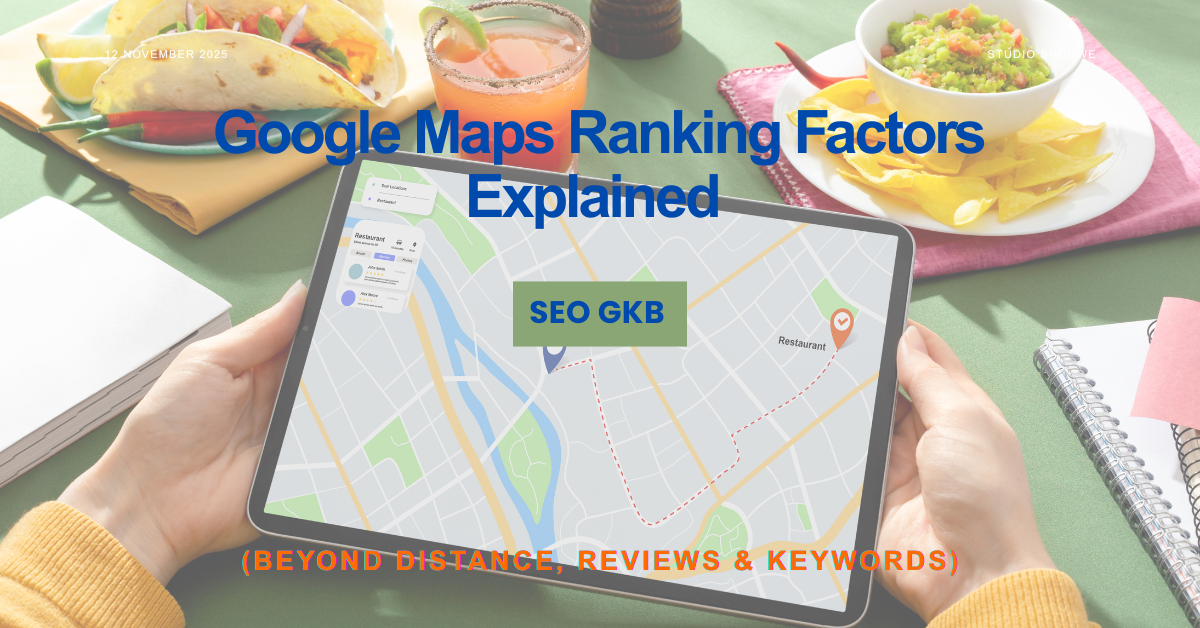
(Beyond Distance, Reviews & Keywords)
Most businesses believe Google Maps rankings improve by adding keywords, getting more reviews, or posting regularly.
Yet many Google Business Profiles remain stuck.
No growth.
No increase in calls.
No real Maps visibility.
This happens because Google Maps does not rank activity. It ranks clarity, trust, and alignment.
This guide explains how Google actually ranks businesses on Maps, what proximity, relevance, and prominence really mean, which ranking factors matter most, which ones are overhyped, and why most Google Maps SEO efforts don’t compound.
How Google Maps Rankings Actually Work
Google Maps ranking is not the same as website SEO.
There is no keyword-to-page matching, no backlink-based PageRank, and no publish-and-rank logic.
Google Maps works on entity trust. Google tries to answer one question:
Which business is the most reliable option for this user, at this location, for this service?
The 3 Core Google Maps Ranking Factors
Proximity
Proximity means how close your business is to the searcher.
Google doesn’t use simple distance. It considers exact user location, road access, map pin
accuracy, and area activity patterns.
You cannot improve proximity with SEO tricks. You can only avoid harming it.
Common mistakes include incorrect map pin placement, virtual office addresses, and frequent address edits.
Relevance
Relevance answers whether your business clearly matches what the user is looking for.
Google determines relevance using primary and secondary categories, services listed, business description, and website content.
If your website and Google Business Profile describe services differently, relevance weakens.
Relevance is not keyword stuffing. It is clear service definition.
Prominence
Prominence is Google’s confidence in your business.
It is built from review quality and language, review consistency, brand mentions, website authority, and user actions like calls and direction requests.
Prominence grows slowly and drops quietly if manipulated.
Google Maps Ranking Factors That Matter More Than You Think
Primary Category Selection
Your primary category decides which searches you appear for, who your competitors are, and how Google understands your business.
Wrong category selection can make your profile invisible.
Best practice is to analyze top-ranking competitors, match service intent, and avoid broad but weak categories.
Website and Google Business Profile Alignment
Google reads your website to confirm services, validate categories, and measure expertise.
If your website is generic, has thin service pages, or lacks local context, your Google Business Profile loses strength.
This is why many businesses do everything but still don’t rank.
Review Context
Google reads reviews like content.
It looks for service mentions, location references, and natural customer language.
Twenty detailed reviews often outperform one hundred generic ones.
Google Maps Ranking Factors That Matter Less Than People Claim
Keywords in Business Name
Keywords in the business name may give short-term visibility but create long-term risk.
Google tolerates it until it doesn’t.
Posting Daily on Google Business Profile
Google Posts help engagement and freshness perception.
They do not build authority on their own.
Citation Quantity
After basic consistency is achieved, more citations do not improve rankings.
Accuracy matters more than volume.
Why Most Google Maps SEO Efforts Don’t Compound
Most businesses treat Maps SEO as tasks such as filling details, adding photos, and asking for reviews.
But Google looks for patterns, not isolated actions.
Without content depth, service hierarchy, internal linking, and entity consistency, rankings stall instead of growing.
The Practical Weightage Model
Based on real-world observation:
- Relevance clarity: 30–35%
- Prominence and trust: 30%
- Proximity certainty: 20%
- User behavior: 10–15%
- Optimization hygiene: 5–10%
Optimization supports rankings. It is not the foundation.
How Google Builds Trust Over Time
Google rewards consistency, predictable growth, and natural engagement.
It does not reward sudden spikes, aggressive tactics, or shortcuts.
Maps SEO is slow by design, but once trust is built, it compounds.
Common Google Maps SEO Misunderstandings
- More reviews automatically improve rankings.
- Posting daily boosts Maps SEO.
- Keywords in business name are required.
- Maps SEO is faster than website SEO.
These beliefs waste months.
How to Use This Knowledge Correctly
- Align website and Google Business Profile language.
- Choose categories carefully.
- Build service-level content.
- Improve user experience.
- Let trust grow naturally.
Google Maps rankings improve when Google understands your business better.
Need clarity on your Google Maps performance?
If your Google Business Profile is active but not growing, a short clarity call can often reveal what’s blocking visibility.
We offer a free consultation to review your current Maps setup, alignment issues, and growth gaps — with no pressure to proceed.